A positive control gives an experiment a useful reference point: a condition expected to produce the response being measured. If the test responds to that condition, an inactive result elsewhere becomes easier to interpret. Yet the reference point also creates a temptation. Similar laboratory signals can look like evidence that two treatments deliver similar benefits. That conclusion changes the question from whether a measurement responds to whether treatments are clinically interchangeable.
Reading retinol research through this distinction makes the methods more informative. The important questions concern which explanation each control tests, how measurements are compared, and what would connect a biological signal to an outcome someone can notice. The worked examples below use invented numbers to expose those reasoning steps; they are not additional study findings or treatment recommendations.
Study figure and data
Retinol: fine-wrinkle scores
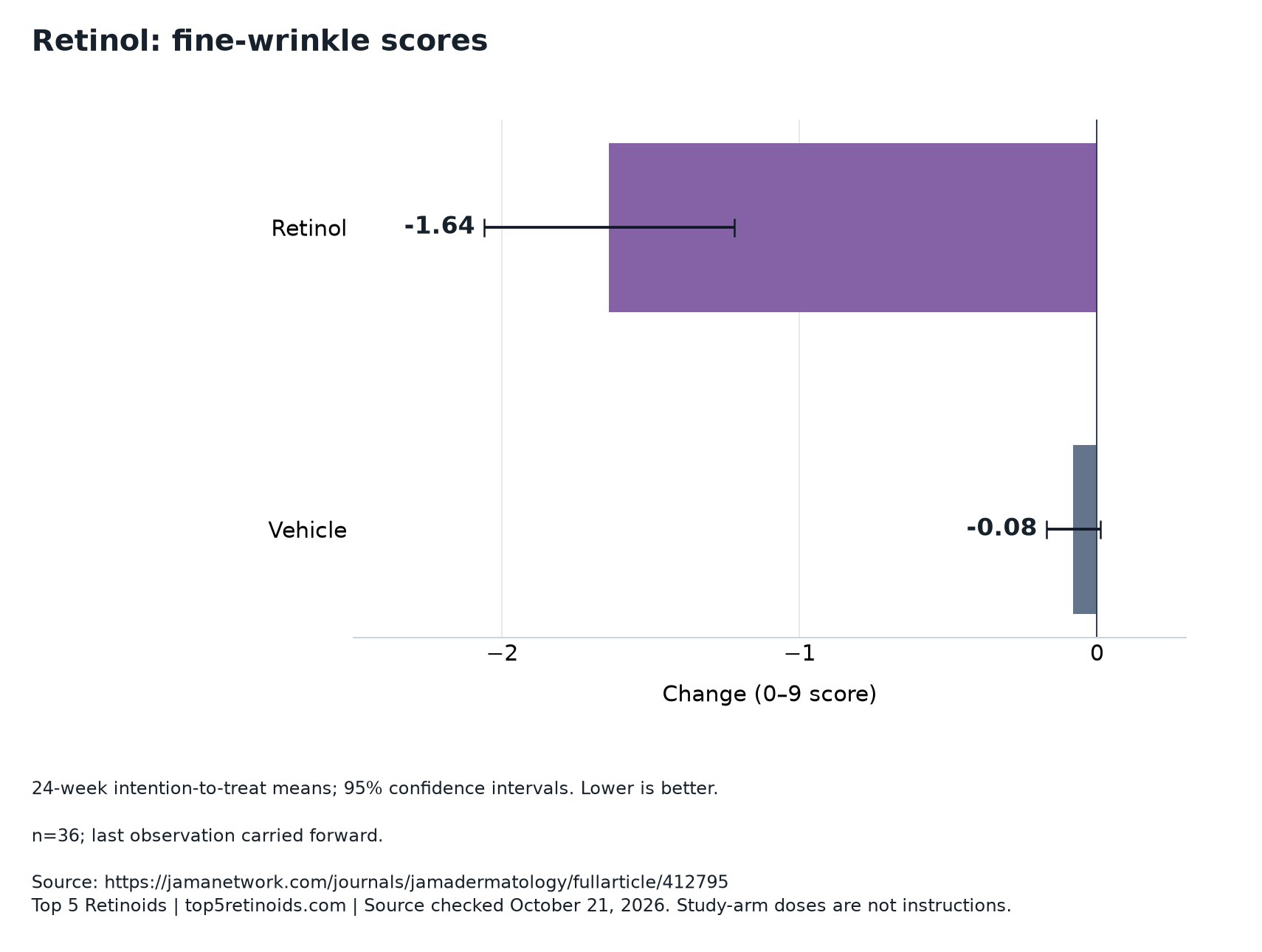
24-week intention-to-treat means; 95% confidence intervals. Lower is better.
n=36; last observation carried forward.
Download chart (PNG)Download data (CSV)Download vector chart (SVG)
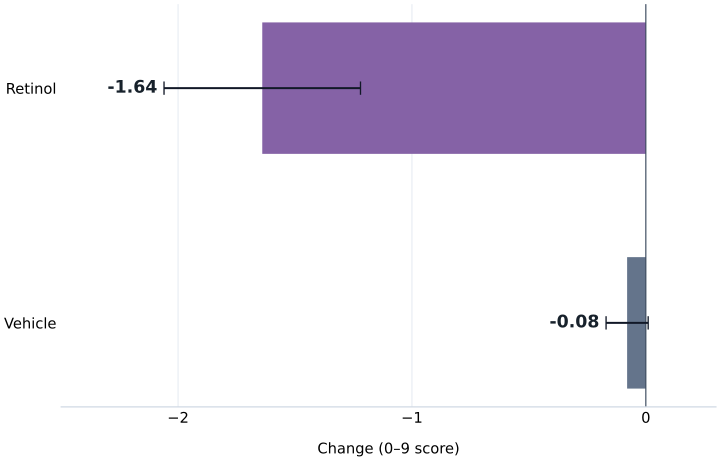
| Study arm | Reported value | 95% confidence interval |
|---|---|---|
| Retinol | -1.64 | -2.06 to -1.22 |
| Vehicle | -0.08 | -0.17 to 0.01 |
Keep the experiments on separate pages
Kafi’s separate assay involved five healthy nongeriatric volunteers, buttock biopsies after 24 hours, and laboratory 0.4% retinol versus vehicle. Retinoic acid was the positive control; its matching carrier was the negative control. Both active preparations induced comparable gene-activity responses. The geriatric paired clinical experiment used that lotion on protected upper arms (mean age 87). Exposure averaged 1.6 applications weekly, versus three planned maximum; 13 withdrew, three for irritation/pruritus. Four inventors disclosed royalties conditional on licensing and product sales; payments and funding remain unestablished.
The useful editorial exercise is to draw a separate box around every experiment before connecting its conclusions. Inside each box, write the people, treatment contrast, measurement and observation period. A conclusion can travel between boxes only through an explicit argument. Shared ingredients or authors do not supply that argument, and adding participants across boxes cannot make either comparison more precise.
A reader can then ask which box a sentence belongs in. Does it describe a molecular measurement, a clinical assessment, or an explanation connecting them? The retinoid family guide provides terminology for this exercise. Naming related compounds correctly is useful groundwork; deciding what a comparison establishes still requires following the actual experimental contrast.
Ask what each control rules out
A control is most useful when it addresses a specific alternative explanation. A carrier comparison asks whether the surrounding preparation could account for a signal. A positive control asks whether the experimental system can produce the expected response under the conditions tested. Those jobs differ. One tests background contribution; the other helps establish that the experiment was capable of detecting the kind of activity under discussion.
Consider an invented assay in which the candidate, its carrier and the positive control all yield a reading of eight. The positive control has not rescued the candidate's interpretation: the carrier also produces that reading. Now imagine the carrier reads two while both active conditions read eight. That pattern supports a different conclusion, because the candidate separates from its own background. Neither pattern assigns a clinical meaning to the number eight.
The conceptual table makes the alternatives explicit. Its rows are predictions for hypothetical experiments, not reconstructed results. This approach also prevents the word control from becoming a vague guarantee of quality. A control that addresses one possible explanation can leave another untouched, so the next step is to name the remaining explanation and design a comparison that addresses it.
| Hypothetical pattern | Question it addresses | Question still open |
|---|---|---|
| Reference responds; candidate does not | Can this setup register an expected signal? | Was candidate exposure adequate? |
| Candidate and carrier respond alike | Is the candidate distinguishable from its background? | What accounts for the shared response? |
| Candidate separates from its carrier | Is there an incremental laboratory signal? | Does that signal predict a clinical benefit? |
| Neither reference nor candidate responds | Did the positive check work? | Can an inactive candidate result be interpreted confidently? |
Distinguish detection from calibration
Showing that an assay detects activity is different from calibrating a scale. Calibration would require a dependable relationship between known inputs and measured outputs across the range of interest. One reference condition supplies one point. It does not reveal the shape of the relationship, whether the measurement reaches a ceiling, or whether different preparations follow the same curve.
For an original illustration, suppose an instrument displays no more than ten units. A hypothetical treatment producing an underlying signal of twelve and another producing eighteen would both display ten. Equal displayed values would conceal unequal inputs. Alternatively, two preparations could reach the same reading through different time courses. A snapshot would then describe their intersection, not their complete trajectories. These possibilities explain why a comparison needs an assay range and timing appropriate to its intended interpretation.
The guide to retinoid percentages addresses the terminology of concentration comparisons. Here the additional question is mathematical: what observations would justify the proposed conversion? A conversion requires more than dividing the concentrations printed beside two assay conditions. It would need reproducible relationships for the relevant preparation, exposure and endpoint, followed by a reason to expect those relationships to hold outside the calibration experiment.
Build the bridge to an outcome
A biological measurement becomes clinically useful through an argument about what it predicts or explains. These are different roles. Prediction asks whether knowing the measurement improves an estimate of a later outcome. Explanation asks whether changing the biological process contributes causally to that outcome. A marker could perform one role without fully performing the other.
Imagine a hypothetical study in which a preparation changes both a laboratory marker and an appearance score. Their coexistence leaves several explanations possible. The marker might contribute to the visible change, both might arise from another process, or the association might reflect differences between participants. To examine mediation, meaning an intermediate causal step, investigators would need measurements and comparisons capable of distinguishing these possibilities. Merely placing two favorable results beside each other does not accomplish that task.
The table sets out an original sequence of questions for constructing that argument. It is a way to identify the next useful experiment, rather than a checklist whose boxes can be filled by any convenient measurement. The strongest next step is the one that tests an unresolved connection directly. Collecting more detail about an already established connection may improve precision while leaving the central clinical question unchanged.
| Proposed connection | Informative test | Insufficient substitute |
|---|---|---|
| Preparation to measurable signal | Candidate compared with its relevant background | A response without a comparator |
| Signal to later outcome | Linked observations with appropriate timing | Separate favorable group summaries |
| Intermediate process to benefit | A design testing competing causal explanations | Correlation alone |
| One treatment to another | A direct comparison on the claimed clinical outcome | Matching laboratory readings |
Put a boundary around similarity
The 1995 indexed abstract describes 99 completers over 48 weeks, comparing 0.1% and 0.025% topical tretinoin with vehicle for facial photoaging. Both active groups improved; their efficacy was similar, while erythema and scaling were greater at the higher concentration. Enrollment, random allocation, attrition, biopsy site, funding and confidence intervals are not established by the abstract.
Similarity has to be interpreted in relation to the question tested. An ordinary difference test asks whether the observations provide sufficient evidence against no difference. An equivalence analysis asks whether clinically unacceptable differences have been excluded. Failure to answer the first question affirmatively does not automatically answer the second. The companion analysis of an explanation for improvement examines a related causal question; a difference in irritation does not, by itself, prove irritation irrelevant.
For a hypothetical equivalence exercise, define an acceptable difference as no more than half a score unit in either direction. A plausible difference range running from minus two to plus two would fail that requirement even if its center were zero. A much narrower range could support it, provided the boundary had a defensible clinical basis. Choosing the boundary after seeing the results would weaken the argument by allowing the answer to determine the question.
Follow the person through a paired comparison
In a paired design, the informative contrast is the difference within each person. This can remove some variation between people, but it creates an obligation to preserve the pairing in analysis. Treating two measurements from the same participant as though they came from unrelated people changes the uncertainty calculation. The number of measured sites is not a substitute for the number of independent participants.
An invented example shows why. Suppose one participant has changes of minus three units at one site and minus two at the comparison site; another has changes of minus one and zero. Their absolute changes differ, but both within-person differences are minus one. An analysis of those differences answers a different statistical question from one that ignores which measurements belong together. This arithmetic describes the design principle, not the numerical result of a published study.
Missing observations require a further decision: what outcome is being estimated for someone who leaves or changes exposure? Restricting analysis to those who remain can answer a selected-population question. Filling a missing observation introduces an assumption about its unobserved value. The irritation guide offers separate practical context; analytically, symptoms matter because exposure and continued observation can become related to treatment response. A sensitivity analysis asks whether reasonable alternative assumptions change the conclusion.
Identify what must travel between populations
Transporting a finding means applying it beyond the people and conditions directly studied. The relevant question is whether a changed feature could alter the treatment contrast. A demographic description alone cannot settle that question. Investigators need an argument about which differences matter, which are incidental, and whether the available observations cover the situations in which the claim will be used.
Consider two hypothetical populations with different starting scores. If a measurement has a lower limit, the group beginning closer to that limit has less numerical room to improve. Identical average changes would therefore not necessarily imply identical experiences. Conversely, different changes need not show that a treatment works through a different mechanism. The scale, baseline distribution and meaning of a score change all belong in the interpretation.
Formulation identity presents a parallel transport question. An ingredient name can identify a topic without identifying the complete intervention. The retinal and retinol comparison guide provides a place to organize product descriptions. Our methodological interpretation is to record every change between the studied intervention and the proposed comparison, then identify which changes have direct evidence behind them. This turns a broad extrapolation into a set of specific, answerable research questions.
Make time and access part of the question
The 2005 indexed abstract reports 204 participants treated with 0.05% tretinoin emollient cream or vehicle for up to two years, with greater improvement in moderate to severe facial photodamage on active treatment. Histology showed no increased keratinocytic or melanocytic atypia relative to vehicle. Publisher acknowledgments document OrthoNeutrogena support and author employment, equity, research and consulting relationships. Full methods and results were not reviewed.
Longer observation can address questions that a short experiment cannot, but duration does not make every measurement equally informative. A research question about persistence needs observations capable of separating continued exposure from continued benefit. A question about cumulative harms needs the appropriate outcomes and follow-up. Neither can be answered merely by attaching a longer time period to the same biological rationale.
The guide to time and evidence helps frame these distinct questions. Access matters because an abstract is a compressed account, while detailed methods can show how a result was obtained. Disclosures answer another question: which relationships are documented. They deserve explicit attention, but they cannot replace examination of design and analysis or be used as a numerical adjustment to an effect estimate. The appropriate response is to identify which additional information would resolve the uncertainty under discussion.
Keep labeling attached to its formulation
The current official RENOVA 0.02% label, available in full, concerns topical treatment of fine facial wrinkles alongside comprehensive skin care and sunlight avoidance. It warns about irritation, increased sunburn susceptibility and pregnancy. Its clinical pharmacology section does not establish how receptor activation, irritation and clinical effects are connected. This formulation-specific document does not supply labeling for cosmetic retinol or other formulations.
A labeling statement and a mechanistic hypothesis serve different purposes. The first describes the authorized product context and its conditions; the second proposes an explanation that can be investigated. Keeping them separate allows a reader to recognize that a treatment claim can have a defined scope even while aspects of its mechanism remain unresolved. An incomplete explanation does not erase observed outcomes, and a plausible explanation cannot expand the scope of a label.
For a documentary comparison, the Curology HydroTret review can be used to check the terms recorded for that offer. This is an editorial route for examining documents, not evidence that the offer matches a research preparation. The useful question is whether a claim names its exact formulation and evidence, or requires the reader to supply an unstated connection. That distinction should remain visible before a laboratory result enters a product comparison.
Write a comparison that could be tested
A useful next research question names the competing treatments, the people of interest, the clinical outcome and the acceptable uncertainty. Asking whether two ingredients are equally good leaves each of those elements open. Asking whether defined preparations yield sufficiently similar outcomes in a specified population creates a proposition that a study could support or reject. It also makes clear which measurements would be informative and which would merely add background detail.
For an original planning exercise, imagine commissioning a direct comparison. Specify the outcome before collecting observations, choose a meaningful difference boundary, preserve comparable follow-up, and decide how incomplete observations will be handled. Include harms in the question rather than assuming that an efficacy comparison answers it. These choices are not a proposed treatment regimen; they describe what would make a comparative claim auditable.
Our editorial interpretation for reviews is similarly concrete: keep the evidence question beside the documentary question. The CoreAge Rx Smooth Move review is a place to inspect recorded offer terms, not a substitute for a direct experiment. A useful review can identify an unanswered comparison without inventing its answer. The resulting conclusion may be narrower than a ranking, but it tells readers exactly what future evidence would need to establish.
Questions about the evidence
Does a successful positive control validate every part of an experiment?
No. It addresses whether the expected response can be detected under the tested conditions. It does not independently settle whether the comparison groups are appropriate, whether measurements are unbiased, or whether the endpoint matters clinically. A useful reading identifies the precise uncertainty the control reduces and keeps other uncertainties separate.
Can matching laboratory responses support a potency conversion?
Only a much more developed calibration argument could support a conversion, and its scope would remain tied to the measured endpoint. A single match does not map the response curve or show that it predicts clinical outcomes. The necessary evidence would connect inputs, responses and the intended clinical comparison across a relevant range.
Why does a plausible mechanism still need a clinical test?
A mechanism describes a proposed route to an outcome. Other routes, opposing effects or differences in exposure can change the final result. A clinical test observes the outcome itself under a defined comparison. Mechanistic evidence can guide that test and help interpret it without determining its answer in advance.
What would make an equivalence claim convincing?
The claim needs a clinically defensible margin, an appropriate direct comparison and enough precision to exclude differences beyond that margin. Analysis choices and incomplete observations also matter. Similar point estimates are a starting observation; the key question is whether the range of plausible differences fits inside the prespecified boundary.
How should financial disclosures affect interpretation?
Record what relationship is documented and consider how independent replication or fuller methods could strengthen confidence. Do not turn a disclosure into proof that a result is false, or treat the absence of a named payment as proof of independence. The scientific assessment still requires examining the comparison, measurements and analysis.
Editorial assessment
The strongest use of a positive control is to make an experiment more interpretable. Our assessment separates that contribution from calibration, causal explanation and clinical comparison. Each requires a different evidentiary connection. Reading the control in its proper role preserves useful biological information while making the next research question more precise: what direct comparison would establish the outcome being claimed, in the people and preparation to which the claim will apply?
Research access and limitations
The worked examples and conceptual tables are original explanatory tools, not additional empirical findings. A citation identifies the research or labeling context for the reasoning; it does not turn a hypothetical example into a reported result. The discussion does not calculate clinical potency equivalents or provide individual treatment instructions.
Sources and access notes
- Improvement of naturally aged skin with vitamin A (retinol).
Full publisher research article, including original clinical table-image footnote, figure captions, Comment and Financial Disclosure; no supplements or individual data reviewed. · Checked October 21, 2026
- Two concentrations of topical tretinoin (retinoic acid) cause similar improvement of photoaging but different degrees of irritation. A double-blind, vehicle-controlled comparison of 0.1% and 0.025% tretinoin creams.
Indexed original research abstract · Checked October 21, 2026
- Long-term efficacy and safety of tretinoin emollient cream 0.05% in the treatment of photodamaged facial skin: a two-year, randomized, placebo-controlled trial.
Indexed original research abstract plus publisher acknowledgment and financial disclosures; full methods and results not reviewed. · Checked October 22, 2026
- DailyMed - RENOVA- tretinoin cream
Official current labeling retrieved in full · Checked October 21, 2026