An explanation for improvement should do more than sound biologically plausible. It should predict something that could turn out differently. For tretinoin research, the question is whether irritation contributes to improvement, merely accompanies treatment, or affects the conditions under which improvement is measured. Those possibilities require different comparisons. Treating them as interchangeable makes an unpleasant reaction appear more informative than it really is.
This article uses an older concentration comparison to develop a practical way of testing that explanation. The reasoning below separates observations from causal claims and uses explicitly hypothetical examples where numerical detail helps. It also distinguishes a study of treatment benefit from a study of the pathway producing that benefit. A successful explanation must account for the comparator, the sequence of events, the measurement process and the people who remain observable.
Study figure and data
Tretinoin: epidermal thickness
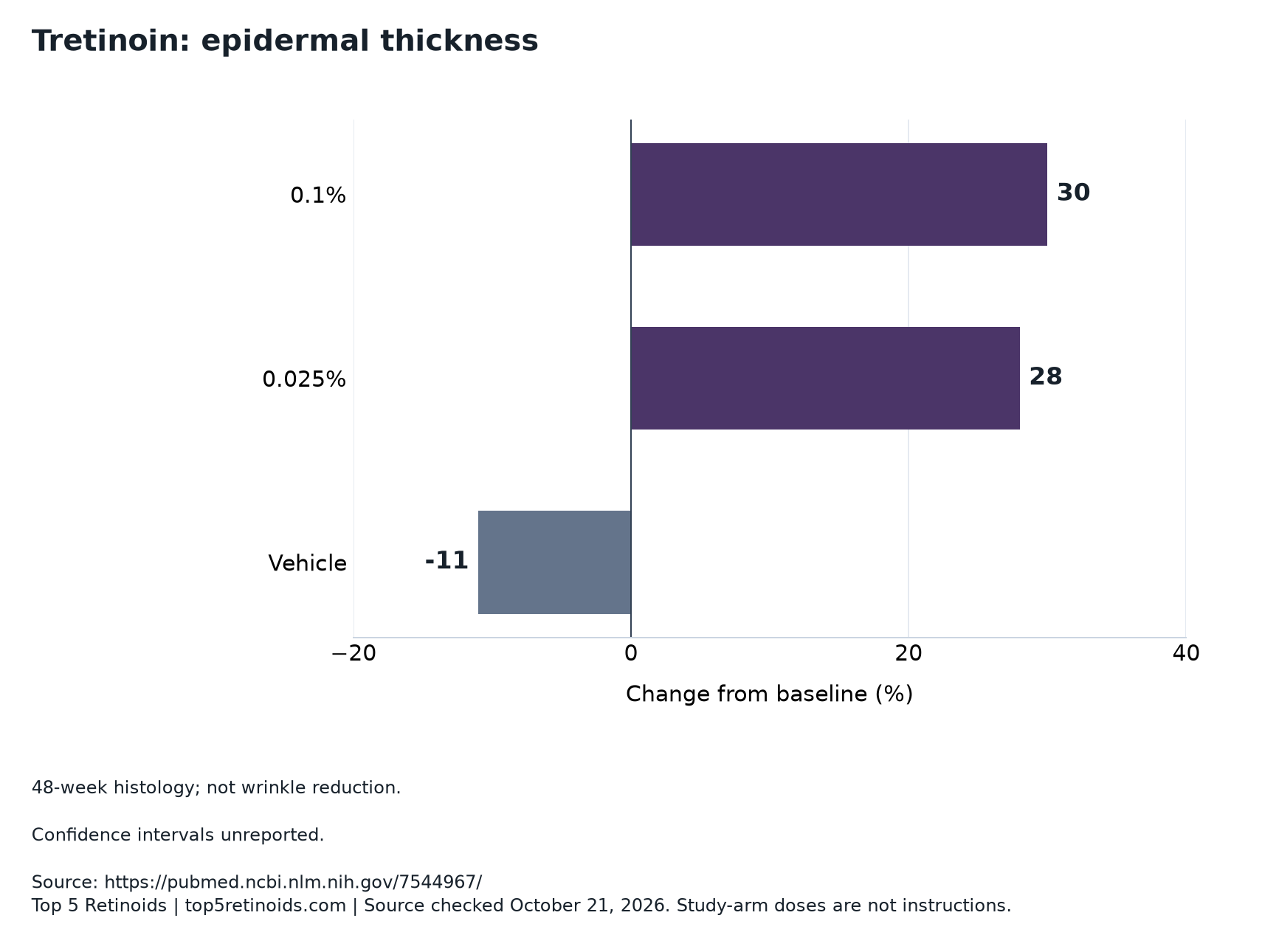
48-week histology; not wrinkle reduction.
Confidence intervals unreported.
Download chart (PNG)Download data (CSV)Download vector chart (SVG)
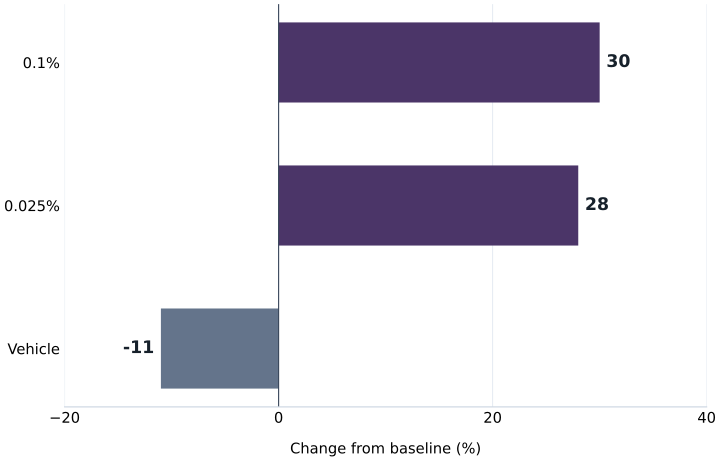
| Study arm | Reported value |
|---|---|
| 0.1% | 30 |
| 0.025% | 28 |
| Vehicle | -11 |
Turn an appealing explanation into a test
The 1995 indexed abstract reports 99 completers with photoaging; enrollment, allocation method, attrition, biopsy site and funding are unreported. Both active creams improved facial photoaging versus vehicle, with similar observed efficacy but more erythema and scaling at the higher concentration. Double blinding is stated; random allocation is not. The pattern challenges a simple irritation-proportional explanation without establishing equivalence or proving irritation irrelevant.
The methodological interpretation starts by making the proposed relationship precise. Does any irritation have to occur before improvement becomes possible? Does additional irritation produce additional benefit? Or might irritation contribute only under certain circumstances? These are separate hypotheses. An observation that challenges the second need not settle the first or the third. A useful explanation identifies its own vulnerable prediction rather than changing its wording after every result.
That distinction also prevents a research question from becoming a personal target. The guide to interpreting irritation addresses the practical topic; here, the issue is what an experiment must distinguish. Discomfort is an outcome to record, not an assumption that supplies a missing causal link.
Compare predictions before choosing a mechanism
As an original reasoning exercise, imagine three possible accounts. In a proportional account, increasing the proposed mediator should increase the benefit across the relevant range. In a threshold account, a small amount could be sufficient and additional amounts uninformative. In a parallel account, treatment could produce both responses through different pathways. All three might initially fit a report that mentions improvement and irritation together.
The table gives conceptual predictions, not findings from an additional trial. Its purpose is to show why a single comparison rarely selects a unique mechanism. A result can make one explanation less convincing while leaving several others plausible. The next experiment should target the remaining disagreement rather than merely accumulate another favorable outcome.
A further discipline is to state the range over which the prediction should hold. Otherwise an investigator could explain every inconvenient observation by proposing an unspecified plateau. Thresholds and plateaus can be legitimate hypotheses, but their location and expected behavior should become testable commitments, not permanent escape routes.
| Proposed explanation | Prediction to examine | What remains unresolved |
|---|---|---|
| Proportional contribution | More mediator should predict more benefit within the stated range. | Other pathways might offset that relationship. |
| Threshold contribution | Benefit may level off after a specified mediator threshold. | The threshold needs an independent definition. |
| Parallel responses | Both responses may follow treatment without a causal link between them. | A shared response alone cannot identify the pathway. |
Separate a mediator from a fellow traveler
A mediator is an intermediate step through which a treatment produces an outcome. Calling irritation a mediator therefore asserts a sequence: treatment changes irritation, and that change helps produce improvement. Simply finding that people with more irritation also improve more would not establish the sequence. A common influence, such as greater exposure, could affect both responses without irritation carrying the benefit.
Consider an entirely hypothetical dataset in which diligent participants receive more treatment, report more symptoms and also show more improvement. A symptom–improvement correlation could arise even if preventing the symptoms would leave the benefit intact. Conversely, a true contribution could be hidden if people with stronger symptoms receive less subsequent treatment. The direction of the observed correlation alone cannot distinguish these situations.
This is why adjusting a statistical model for irritation is not automatically a mechanism test. Irritation occurs after treatment begins; selecting people by that response can assemble groups with different exposure histories or susceptibilities. A careful analysis needs an explicit account of what is being held constant, what is being compared and which common influences remain unmeasured.
Put events in the order the claim requires
Timing gives a causal explanation an additional burden. If an event is proposed to produce a particular improvement, it must happen before that improvement, with a plausible interval between them. Recording both at the final visit does not establish their order. A prospective mechanism study would therefore need repeated observations of exposure, symptoms and the outcome, rather than only a beginning and an end.
For a hypothetical example, suppose symptoms are recorded on day ten and improvement is first assessed on day thirty. That schedule establishes when the researcher looked, not necessarily when either process started. Improvement might have preceded the recorded symptoms, or an earlier symptom episode might have gone unrecorded. More frequent observations reduce this ambiguity but do not independently remove common causes.
The guide to retinoid timelines provides related context for evaluating time claims. In a mechanism analysis, the useful question is more specific: does a change in the proposed intermediate step predict a later change in the outcome after accounting for earlier outcome levels and exposure? Even that temporal pattern would support investigation rather than complete the causal argument.
Give a small difference a precise meaning
Two separate statistical questions often become blurred. A superiority analysis asks whether the evidence distinguishes treatments. An equivalence analysis asks whether differences larger than a prespecified acceptable margin can be excluded. Failure to answer the first affirmatively does not answer the second. The margin also needs substantive justification: it defines what size of difference would matter for the specific outcome.
In an invented example, two treatments differ by one tenth of a score point. If the uncertainty around that comparison extends well beyond the proposed acceptable margin, the result remains inconclusive for equivalence despite the small observed difference. If a well-designed analysis places the entire compatible range inside a defensible margin, that would answer a more demanding question. These imagined values describe the logic, not the tretinoin data.
This distinction matters for the mechanism argument because an imprecise outcome comparison can leave room for a meaningful difference. It also matters when reading percentage-based strength comparisons. A concentration label identifies an experimental condition; a statistical conclusion requires an outcome, a comparator and enough precision to address the actual claim.
Follow the feedback between symptoms and exposure
Kafi’s full article describes a separate randomized paired-arm study: participants averaged 87 years, receiving laboratory-made 0.4% retinol lotion or vehicle on protected upper arms. Of 36 enrolled, 23 completed; 13 withdrew, including three for irritation or pruritus. Planned exposure was up to three applications weekly; actual exposure averaged 1.6 with irritation-related withholding. Four inventors disclosed royalties conditional on licensing and sales, not established payments or sponsorship.
The methodological lesson concerns feedback. In a study where symptoms influence subsequent exposure, treatment is a sequence of decisions and responses. A comparison based only on initial assignment and final symptoms can miss that sequence. Stronger early reactions could lead to less later exposure, changing both the observable symptom burden and the opportunity for improvement.
A future analysis could distinguish the effect of assignment to an entire management strategy from the effect of a particular amount actually received. Neither question is inherently superior, but they answer different needs. Comparing only those who tolerated continued exposure also changes the population under study. The relevant record includes interruptions and withdrawals, rather than treating them as administrative details outside the biological question.
Keep the measurement separate from the explanation
A tissue measurement and an appearance rating describe different objects. The first may quantify a sampled structure; the second may summarize a visible feature. Even when both change, a causal explanation must connect them. A percentage change in one cannot be relabeled as the percentage improvement in the other, because their units, denominators and meanings differ.
Imagine, hypothetically, a structural measure increasing while an appearance score improves. Several accounts remain possible: the structural change contributes to the appearance change, both follow another process, or the observed association depends on how samples were selected. To discriminate among them, investigators would want measurements from the same people, a sensible temporal order and a prediction about how variation in the intermediate measure relates to later appearance.
Our companion article, Retinol research: what a positive control can establish, examines another step in that chain: establishing that a measurement system responds. An informative laboratory response can justify further study without substituting for the clinical endpoint. Likewise, a clinical response can be credible while its precise biological explanation remains incomplete. The strength of one claim should not be borrowed to inflate another.
Use longer observation to answer a different question
A 2005 abstract describes 204 participants treated with 0.05% tretinoin emollient cream or vehicle for up to two years, with better clinical photodamage outcomes and no increase in specified histologic abnormalities versus vehicle. Publisher acknowledgments document OrthoNeutrogena support and employment, equity, research and consulting relationships. This analysis uses the abstract and disclosures, not the full methods and results.
Longer observation can address persistence and the accumulation of measured outcomes. It does not automatically isolate the pathway responsible for them. A treatment could maintain a benefit through several mechanisms, and an extended comparison might still be unable to separate those mechanisms. Follow-up length should therefore be matched to the question rather than treated as a universal multiplier of evidentiary strength.
The same reasoning applies to safety. Absence of a difference in a specified measurement does not establish absence of every possible harm. An informative report identifies which outcomes were monitored, how often, and among whom. Financial disclosures belong beside that interpretation: they help readers examine incentives and reporting choices, but they neither erase an observation nor supply the missing design details needed to explain it.
Keep regulatory scope distinct from causal inference
Current RENOVA labeling concerns its 0.02% tretinoin cream for mitigation of fine facial wrinkles alongside comprehensive skin care and sunlight avoidance. It warns about local irritation, photosensitivity and pregnancy, and leaves the relationship between proposed biological mechanisms and clinical effects unresolved. These statements are specific to that formulation and do not establish outcomes for other products.
Editorial interpretation: a product document answers questions that a mechanism argument cannot settle, including the named formulation and the limits attached to its use. Conversely, a label is not a substitute for reconstructing an experiment’s causal logic. Keeping these roles distinct makes it easier to notice when a commercial explanation crosses from an ingredient name to an unsupported promise about a finished product.
For documentary comparison, use the Musely review and Curology review to check the terms described there against the documents available for the particular offer. The retinoid price-check guide can organize that separate comparison. None of these links supplies evidence that a reviewed service delivers a research formulation or reproduces a trial’s outcomes.
Design the next comparison around the remaining doubt
A stronger mechanism study would begin with a causal diagram in words: treatment, proposed intermediate response, later benefit, and influences that might affect more than one of them. It would specify the primary clinical outcome and the mechanism prediction separately. That prevents success on an exploratory laboratory measure from silently replacing an unanswered clinical question.
One possible research strategy would examine an intervention intended to alter irritation while preserving the treatment’s other relevant effects. Its interpretation would depend on demonstrating that preservation; otherwise the added intervention could change the benefit through an independent route. Such a design would require appropriate scientific and ethical review, not deliberate pursuit of symptoms by an individual reader.
The table outlines complementary evidence needs. No single row guarantees causal identification. Together they show how a future study could narrow the plausible explanations and make its remaining assumptions visible. The practical standard is an explanation that survives competing predictions, rather than one that merely accompanies a favorable outcome in the same report.
| Design question | Useful evidence to plan | Interpretive failure to avoid |
|---|---|---|
| Did the intermediate response precede benefit? | Repeated measures aligned with exposure history. | Treating the final visit as a complete timeline. |
| Could a common influence explain both responses? | Prespecified measurements and a causal analysis plan. | Assuming statistical adjustment removes every shared cause. |
| Does changing the intermediate response change benefit? | A justified intervention with checks for other effects. | Attributing all consequences to one altered pathway. |
| Do conclusions survive incomplete follow-up? | Sensitivity analyses tied to plausible missing outcomes. | Equating the remaining observations with the original population. |
Questions about the evidence
Does a symptom occurring before improvement prove a causal link?
No. Earlier timing is necessary for that particular causal story, but it is insufficient. Exposure or another shared influence could precede both events. A persuasive analysis must show why the symptom carries part of the treatment effect rather than simply marking another process. Repeated measurements help establish sequence; appropriate comparisons and assumptions address the remaining alternatives.
Why is matching people by their symptoms potentially misleading?
Symptoms develop after treatment begins. Selecting people with similar symptoms may select different exposure histories, susceptibilities or reasons for continuing. The resulting groups can differ in ways relevant to improvement. The original methodological question is whether the selection preserves a fair comparison, not merely whether the visible symptom categories look balanced.
Could a mechanism matter without explaining the whole benefit?
Yes, as a logical possibility. A treatment could act through several pathways, and their contributions could vary across circumstances. Establishing any contribution is different from establishing that the pathway is necessary, sufficient or dominant. An informative research claim states which of those propositions it tests and what evidence would count against it.
Would identical outcome scores establish identical biological effects?
No. The same score can result from different combinations of processes, and a scale can compress changes that it was not designed to distinguish. Mechanistic identity requires additional measurements and predictions. Even a rigorous equivalence conclusion for one clinical endpoint would remain a conclusion about that endpoint under the studied conditions.
What should a reader look for in a proposed explanation?
Look for a defined outcome, an explicit comparator, an ordered sequence and an observation that could falsify the explanation. Then ask whether incomplete follow-up, changes in exposure or measurement choices could reproduce the same pattern. This approach makes a biological story inspectable without requiring the reader to accept a concentration label or a symptom as proof.
Editorial assessment
The strongest reading keeps treatment effects and explanations of those effects on separate evidentiary tracks. A useful mechanism account makes a specific prediction, confronts alternatives and explains the sequence connecting exposure to outcome. The comparisons discussed here provide reasons to formulate sharper questions, while the hypothetical examples show what additional evidence would make those questions answerable. Neither discomfort nor a plausible laboratory story should substitute for the comparison required by the claim.
Research access and limitations
This is methodological interpretation of the accessible records identified in the references. Hypothetical examples and conceptual tables are original explanatory devices, not reconstructed participant data. The discussion does not prescribe a formulation, concentration or personal treatment schedule.
Sources and access notes
- Two concentrations of topical tretinoin (retinoic acid) cause similar improvement of photoaging but different degrees of irritation. A double-blind, vehicle-controlled comparison of 0.1% and 0.025% tretinoin creams.
Indexed original research abstract · Checked October 21, 2026
- Improvement of naturally aged skin with vitamin A (retinol).
Full publisher research article, including original clinical table-image footnote, figure captions, Comment and Financial Disclosure; no supplements or individual data reviewed. · Checked October 21, 2026
- Long-term efficacy and safety of tretinoin emollient cream 0.05% in the treatment of photodamaged facial skin: a two-year, randomized, placebo-controlled trial.
Indexed original research abstract plus publisher acknowledgment and financial disclosures; full methods and results not reviewed. · Checked October 22, 2026
- DailyMed - RENOVA- tretinoin cream
Official current labeling retrieved in full · Checked October 21, 2026